
The running joke in the Bay Area is that, in order to afford living here, one must have a profitable side hustle. Luckily for me, I recently how realized my hobby could become some extra cash. Graded sports cards are underutilized investment vehicles that have a strong demand, with a supply that hasn't caught up - this is my breakdown of why I'm in both the hobby and hustle of sports cards.
If you know me, you probably know my room is littered with copies of sports cards in an semi-organized manner. I've always loved sports, particularly baseball. Growing up in the nineties and aughts, society was inundated with the "Junk Era" of sports cards. Similar to Beanie Babies and other collectibles, there were millions of cards produced and a hobby shop on every other street corner. Unfortunately, the game of baseball itself became marred by steroid usage, and the massive overproduction of cardboard caused the vast majority of these cards to become worthless. That was a perfect petri-dish for an eight year old kid who idolizes athletes and doesn't care about worth. I could sit for hours reading statistics on the backs of cards. I eventually lost some interest as I grew up through high school/college and realized I wasn't going to play in the MLB, but still kept the cards tucked away in a box.
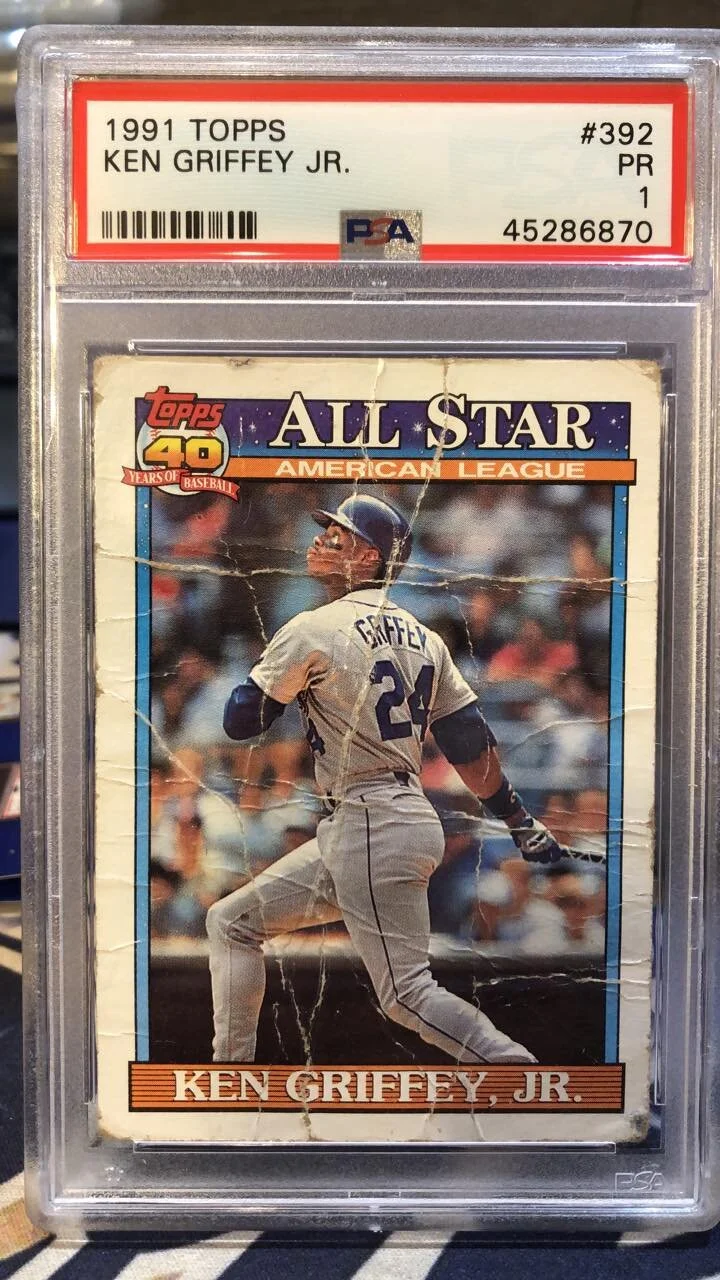
Cards as a hobby - The card on the right is a 1991 card of Ken Griffey Jr., manufactured by Topps. It is in utterly horrible condition, and received the lowest grade possible of "Poor - 1". I got it graded/encased because it's the first card my dad ever gave me. It has absolutely no financial worth, but is completely sentimental and the cornerstone of my collection. If a fire occurred in my apartment and I could grab one thing, it would be this, no question.
I love cards as a hobby because they act as a talisman to connect me with some of my fondest memories. Every time I see this card I remember being with my dad at Griffey's last hit, walking off the Blue Jays in fall of 2010. I strongly remember the time when my mom came home and surprised me with a pack of cards, which I opened sitting and found pulled an all-star Sammy Sosa. When I see a Russell Wilson card it teleports me to giving one of my fraternity brothers a massive hug after our Seahawks won Superbowl 48. I recall occasions of sitting with close friends and pulling special cards.
The list of memories I attach to cards is endless, and the connection between the hobby and treasured memories in my life is extremely potent. Better yet, they likely always will be, even if my favorite teams are stripped away and sent to Oklahoma City.
Cards as a hustle - My previous post on LinkedIn was five years ago and took a look at millennials and investing in the stock market. While I fully believe that the stock market is an efficient and logical place to invest money, I can't tell you it's that it's fun to do so. Let me know when you see a fantasy stocks league. People don't cheer from the sidelines for companies like they do athletes. If I don't have any investment in, for example, $LOW, I personally don't really care about how well Lowe's does. But sports? Oh man, people love sports, people like following story-lines, and people will cheer for their home team through and through. In my opinion, this pandemic has really emphasized how much the world, particularly the USA loves following professional sports. Sidenote: In my opinion, the fact that we're cutting corners to risk having sports during this pandemic is absurd. But how can I use this hobby to make money? First, let's dive into the basic understanding of the sports card world.
Supply: Sports cards are typically manufactured by a few major companies and put into packs, which consumers can open. Easy enough to understand. The end consumer typically takes a loss here, as there are usually long odds for hitting an autograph or short printed parallel. Many including myself view this as gambling. But, at the end of the day, let's say you've gotten lucky enough to land yourself a card.
Separately, a newer trend I find fascinating is "group breaking", in which a distributor or shop owner ("breaker") will procure boxes of packs from the manufacturer, and open those packs for consumers who have bought into the break. Each customer can buy their team in a "break", claiming the cards for that team. Some consumers will pick teams to chase "hits" and will pay for a team that has a hot rookie, or Hall of Famers' autographs in the checklist, in hopes of there one being in the packs.
Demand: There's various demand for different cards. Some people want a personal collection of their favorite player/team - these are the purists who don't affect the market too much as they'll buy/sell when they choose to. Some people want the hot prospect or rookie to invest in and resell down the road- these are the investors. There are plenty of other reasons, but similar to stocks, the market is dynamic and reacts to performance on the field, speculation, and risk.
Marketplace: In order to exchange money for cards, we need an accepted marketplace. In today's world, that marketplace is primarily eBay, with in-person conventions, forums, and Facebook groups also providing places to connect with others. In the past, cards were usually priced by their "book value". Beckett is a company that sold magazines/books with updated price points. Fortunately, it's 2020 and the current values are visible and public through tools like eBay sold sales, which allows consumers to get a realtime idea of what a particular card may be worth.
Summary: I pull a card out of a pack (or a breaker does for me). I want to sell it because I'm not too high on the player. I can use any of said marketplaces to find someone who values it. Similar to the stock market, investors can buy a card and hold it, hoping the player will improve, be named an all-star, win a championship, MVP award or eventual Hall of Fame induction. It's speculative, and a gamble, dependent on news and statistics and expectations. Although I spent years executing this strategy, just like stocks, I find this to be somewhat uninvolved. I personally can't impact the price of my cards/shares I hold.
I don't play in the professional league, so I have no direct effect on the player's performance in which I hold stock :: I don't work for a company, so I have no direct effect on that company's financials (thus no effect on stock's price)
The consultant in me continued to ask the question "How can I be involved with the value-chain, and how do I manage the risk of this ink-on-cardboard portfolio?"
In the world of collectibles, having something in mint condition is king. For cards, grading services such as BGS (Beckett Grading Services), PSA (Professional Sports Authenticator) exist. They will grade the corners, edges, surface, and centering of a card, as well as an autograph if there is one. These are far and away the two primary and most respected grading services though there has been conspiracy around doctoring cards lately. The grading companies judge each aspect of a card on a 1 to 10 scale, with halfsteps such as 5.5, 6.0, 6.5, 7.0 and so-forth. A grade of a 9.5+ is usually called a Gem. A 10 will be a Gem Mint. There's other accepted terminology, but for modern-day cards from 2010-pres, a BGS 9.5 or a PSA 9 is generally accepted as an average card. Anything above that will go for a premium. For older vintage cards, it will depend on the year/set, as production quality has dramatically increased over time. Once the grading company grades the card and sends it back to the owner, the grading service will update it in a registry, so we can see how our cards stack up against other cards of the same likeness that were submitted. We'll come back to the population reports.

Giannis Antetokounmpo is a younger NBA star, who has the size, strength, and potential to be the face of the league a la MJ, Kobe, and LeBron. If I think a Giannis card in my collection is in great condition, I'll submit it for grading. The grading cost will be standardized on a scale, based on how quickly I can expect the card back by. If I want it back in five business days, it'll cost $90. This is often used for products that were just released, and owners want to get graded cards into the marketplace ASAP. If I can wait for a bulk shipment with no guaranteed return date, it'll cost $13. The latter is my preferred option from a cost-basis, as I'll send cards for grading in the sport's offseason, and then hopefully have them back at the beginning of the season, hoping the players perform well. Of course, there is no guarantee on the grade, so for a couple months I'll sit twiddling my thumbs and crossing my fingers until I get them back.
I strongly believe Giannis is a great buy because of his ability to improve, his likeliness to win another MVP this shortened season, and his potential to eventually win a championship. If any or all of those things happen, there will be an increase in demand, thus shooting the prices higher. Unfortunately for me, Giannis rookie cards have exponentially increased in price over the next few years, because many people have the same notion. Right now, I can't afford a rookie card, so I'll have to figure out how to identify the strongest card candidates outside of those.
For current superstars such as Mike Trout, Giannis, LeBron James, Tom Brady, and Sidney Crosby, there is a steep drop-off from their rookie years to their second years, but much softer decline from their second to third years etc. For rookies in their first or second year who have high potential but high volatility, their cards can be had at a lower spending tier.
Here's where I saw the opportunity to add value. For the folks at home who didn't go through Accounting 201, Profit = Revenue - Cost. If I am holding a Giannis card, it may shoot up 10% by the end of the season. I will have no increase in cost other than storage (it's a piece of cardboard, it costs me 0 to store). My revenue will have increased by 10%. Awesome, but it carries some risk. What if Giannis gets injured? What if he gets sick? What if he just doesn't have a good season?
I don’t actually submit the cards myself for grading, I have someone I know and trust do it because he does this for a living, utilizes jewelers loupes, and has consistently high returned grades. He’ll let me know if the cards I send him are worth grading or not.
When I choose to submit/grade a card, my assumption is that the value of the card will go up. Unfortunately, my cost of obtaining that card also went up, so in order to increase profit I need to have an equal-or-greater increase in the revenue. Luckily, for the right cards, the increase in revenue is significantly higher, coupled with the fact that the high-ceiling of a player like Giannis will lead to future increases. Begs the question, how do I identify these cards with the highest possible return? NB - COVID has dramatically affected the sports card market and prices across the board have literally doubled or more over the past months. I'm unable to identify consistent reasons why.
Let's hop back to the population reports produced by grading services. After I filter down, they'll tell me how many cards got which grade. I then download that report and plug it into Excel. I massage the data to show me, of all the cards submitted across every set and year, which ones are the most likely to Gem (9+) at PSA. This will tell me the percentage of raw cards that turned into Gems and Gem Mts (10), and will give me a ballpark estimate of what rate a card will gem at.
From left to right, we've got the year & set name, the card and parallel identifier, and the checklist identifier. Then I filter down just to see the submission numbers for the Mints (9) and Gem Mts (10), and calculate percentages. After that's done, I'll head to eBay where I can view final sales. I'll manually plug in the average of the last three sales for the 10 and 9 grades. Add the cost of a grading fee, the eBay selling fees, and the cost of the raw card. I'm pretty confident in my submitter's ability to get 9s and 10s.

After I fill in all the prices and run the formula, I can see that, if I were to buy a 2018 Panini Prizm Giannis Antetokounmpo (highlighted card), I can expect a return of around 433.14% assuming the demand for the card stays the same. That's for his 5th year card. Sweet! This model shows me I can take a $7 investment in a raw card, and make it a $71 card if it Gem Mints, or a $21 card if it Gems. The expected revenue given the ratios would be $63.91, and the expected profit would be $30.32. The hunt then begins to find a small lot of raw cards that haven't been graded, and purchase them around the raw cost. How do I figure that out? That's a secret I'll never tell. Sorry.
In my opinion, a $7 buy-in of the right 5th year Giannis card is well worth it. If you look at the chart above, the 2018 Panini Revolution Giannis (different set, same year) has even better expected returns. Add in the fact that I think Giannis will improve, he'll win this year's MVP and others, and might win a championship, and I can speculate that the demand for his cards will go up. Now, if I hold the raw cards, and these cards shoot up to $11 each by the end of this season, that's a solid increase, but I'll still be hurting because of expected selling fees on eBay/Paypal. By grading the cards, they significantly increase in value to offset selling fees, and end up as a more profitable product. My $7 becomes $70+ (again, assuming no injuries etc. in the near future, season plays out, etc.), which totals to $30 in profit per card. If I'm impatient or think I can buy low, I may even buy an already-graded card or two.
Not only does the $7 raw 5th year card have a high ceiling, and high rate of gem return, but it's a modest investment instead of the $2,000 raw rookie card of the same player. It allows me to buy into the speculation and potential and a minimal price point
Timing the grading is also part of the risk. If a product comes out and we don't have enough of a turnaround time to grade, we're stuck with the following scenario- I was/am a massive believer in the Seattle Mariners' rookie Kyle Lewis. I bought as much as I could at less than a dollar a rookie card, because I thought if he performs well the profits are potentially there. Luckily for me, he's come out of the gates mashing the baseball and is a strong contender for Rookie of the Year. I find this particular case absolutely fascinating because nobody including myself saw Kyle Lewis's catching fire as much as he is. If you're to search marketplaces, there are almost no copies of this graded rookie card, which is leading to an incredibly high price point. Unluckily for me, I sent a large lot of rookie cards to get graded in June, which means they're still getting graded while the very few available in the marketplace are sky high in prices. Now I'm stuck waiting, hoping that these cards not only grade well, but are back in time before the market loses interest.
-------------------------------------------------------------------
My math and thinking says that by identifying cards which can have value added to them, I'm able to spread out my investment risk and hopefully increase my profits. That's not wholly why I play this game, though. At the end of the day, my $DIS stock shares aren't conversation pieces as much as a perfectly graded PSA 10 Ken Griffey Jr. rookie card can be. I'm not suggesting to get into this world as investment vehicles using the method I'm using unless you really are truly interested and have the time, but I am a strong proponent of using the occasional sports card as investment vehicles. They have shown to have solid returns, and they're way more fun than stocks. If I'm being honest, the pandemic has made this speculation both fun and risky. Any team can win an MLB World Series (except the Mariners because we're cursed), which leads to more theorizing of young rookies who can carry their team to the playoffs or get hot for a shortened season.
Overall, there are a ton of assumptions and a little flawed logic, but the overarching points ring true. I don't spend time cheering for companies (sans Airbnb, love you guys to death and will cheer you on forever!), but I do spend lots of time watching sports and cheering for teams/players/narratives. Finding a way to create value and turn the hobby of sports cards into a sustainable side-gig has been a blast for me. I think the hobby world of sports card collecting will continue to grow, and investing using my strategy is one way I love to stay involved with sports while making a somewhat-logically backed financial decision.
Caveats: Of course, not every card is graded - the cards that are shown in the pop report are often higher quality and more likely to gem than an average one. I don't have perfect eyes, my submitter doesn't have perfect eyes, and the graders aren't robots- they have good and bad days. I don't know how many people have resubmitted the same card for grading, in hopes of a better grade. Oftentimes, I don't know the total population/production for a card. Part of this market is projecting how well players will do. There are no athletes' earning reports. Tons of other factors I just don't know. I'm okay accepting those unknowns, and try to work those into my model separately.
And before you ask, sorry, your 1985-1999 cards are likely not valuable at all even if graded, unless they have Ken Griffey Jr. on them.